Xi'an Greentown·Chang'an Yuhua
-
Location
Shanxi, Xi'an
-
Client
GREENTOWN
-
Design
GOA
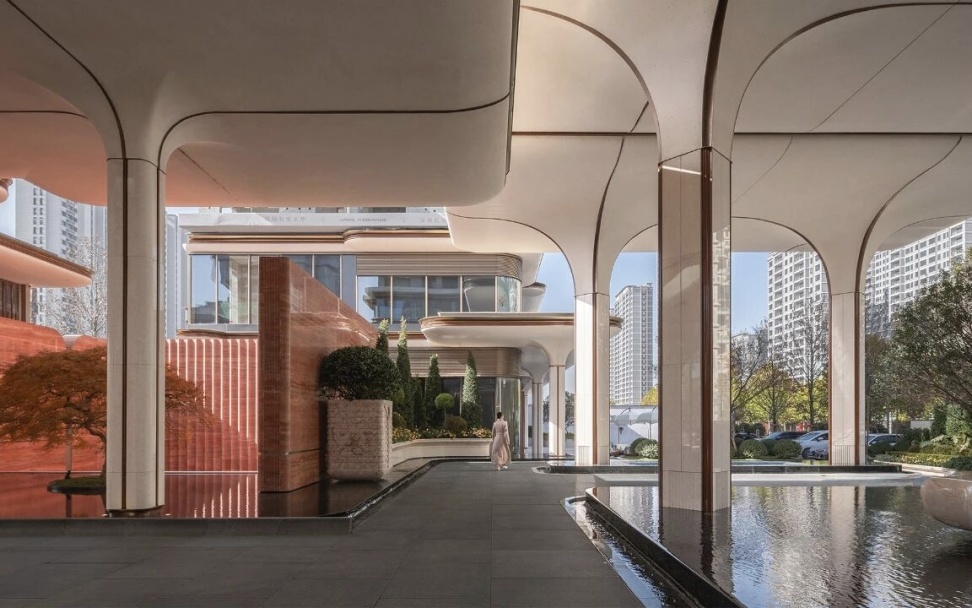
Greentown·Chang'an Yuhua,as a landmark project marking the debut of Greentown's"Yuehua Series"in Northwest China, embodies the spiritual core of "the elegant charm of Yuhua reflecting Chang'an."It's not just about providing a residence but a deep practice of the"Good House"philosophy—elevating from physical space to a carrier of emotion and humanism.
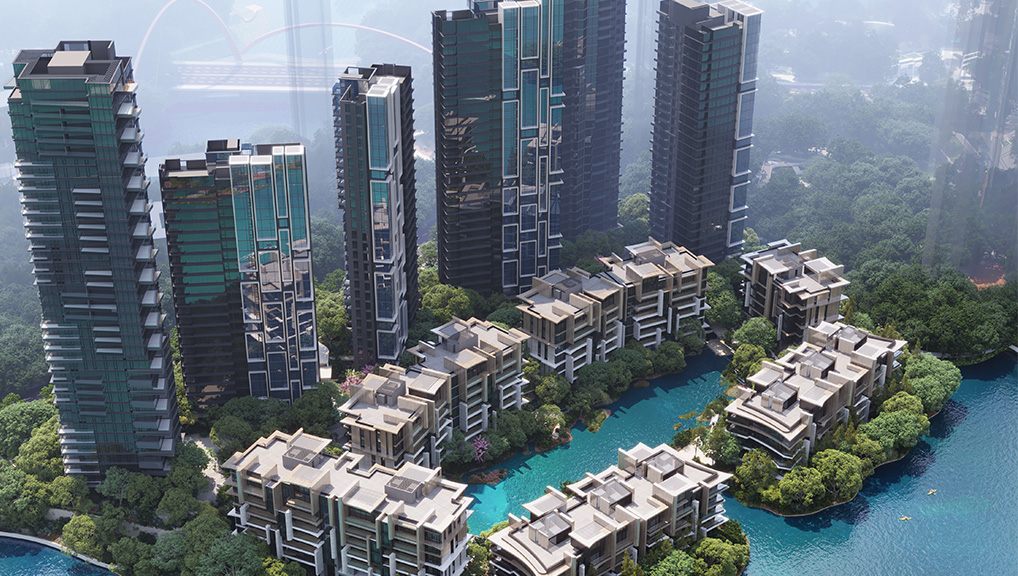
The project takes "jade" as its soul, transforming its warm, resilient, and subtle qualities into perceptible spatial experiences."Hua"signifies a restrained radiance and vibrant vitality. It condenses the majestic landscape of the Qinling Mountains into the layered artistic conception of the community, allowing the architecture to grow like "jade trees" within the historical scroll, creating a poetic "forest valley" sanctuary that blends Eastern tranquility with international paradigms.
01
Chang'an Yuhua is situated in the core hinterland of Xi'an High-tech Zone, enjoying a mature network of industrial, commercial, and ecological amenities.
Chang'an Yuhua adopts "interpreting profundity with lightness" as its design philosophy, comprehensively transforming the warmth and resilience of "jade" into perceptible spatial experiences:
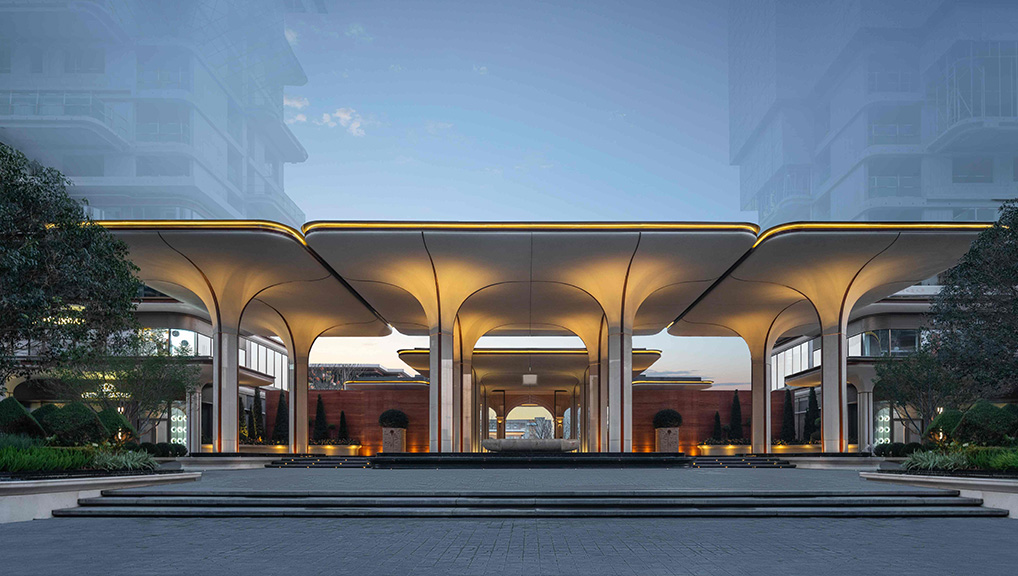
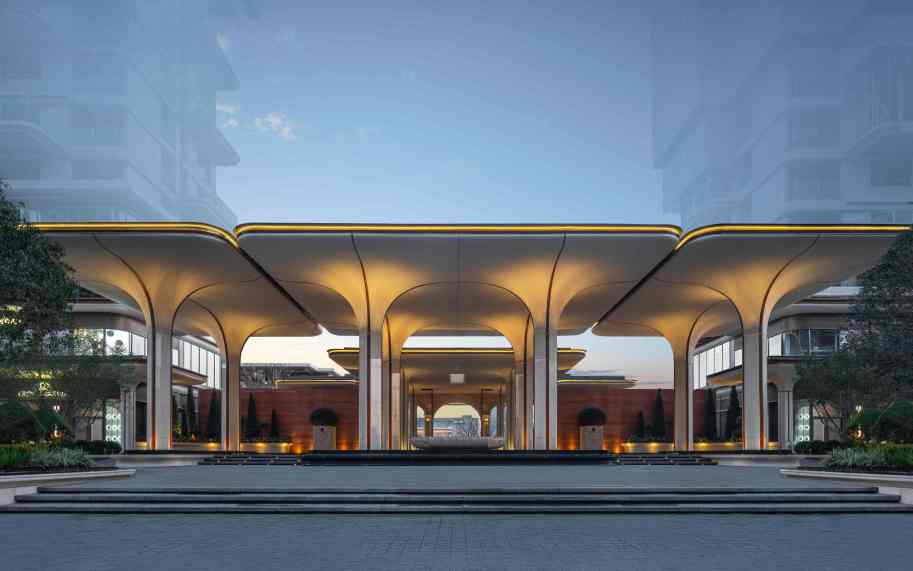
The project unfolds the journey home with a "one axis, three entries" spatial sequence. An imposing "Jade Tree" gateway, approximately 120 meters wide, forms a stunning urban interface.
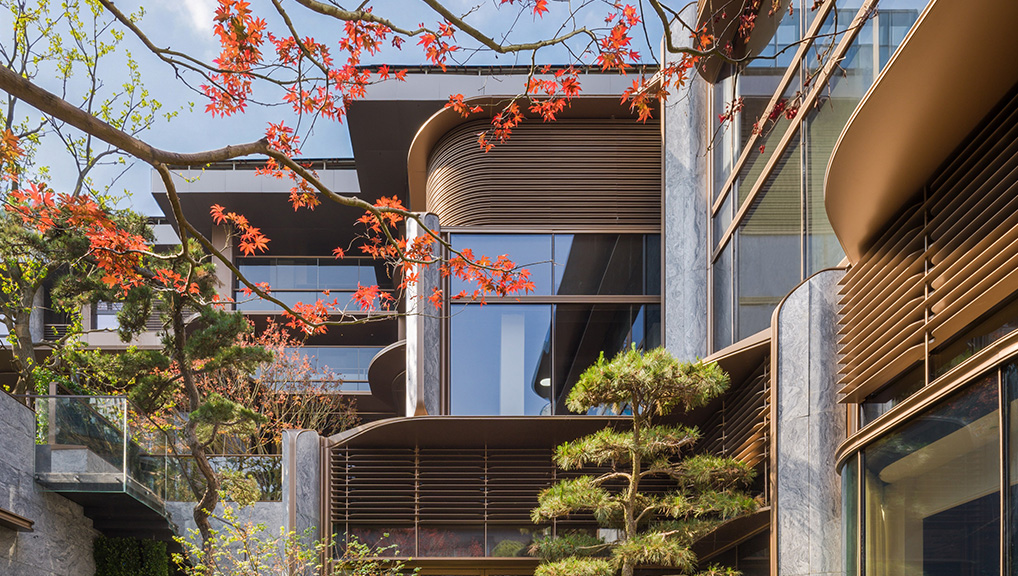
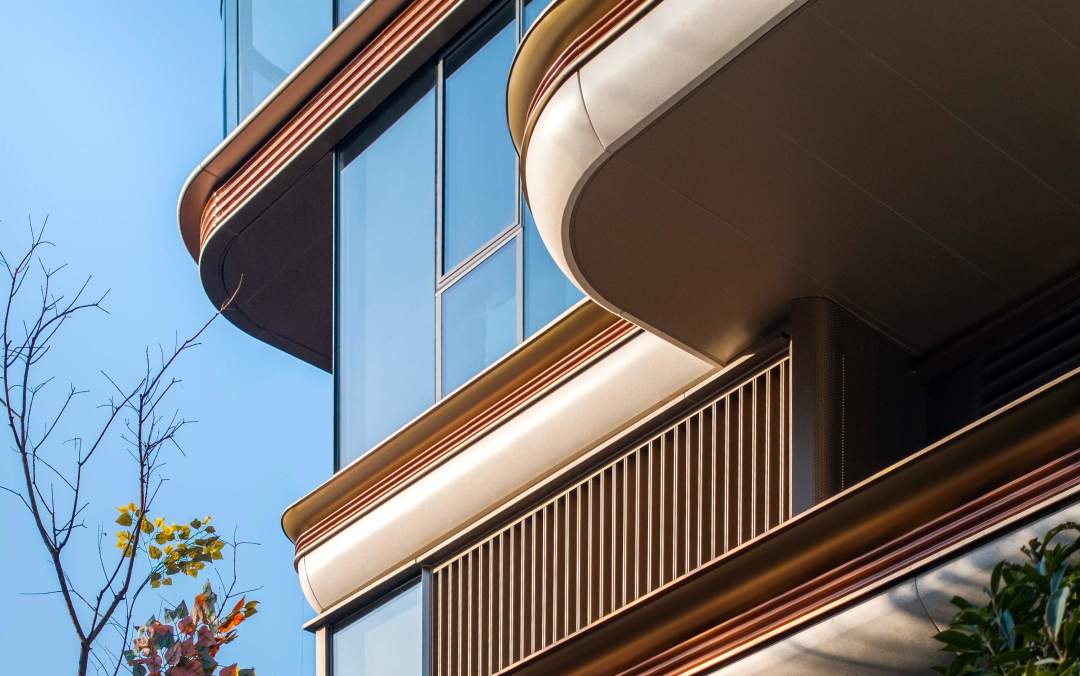
The architectural facade features an original "gold inlay jade" aesthetic, with large-scale custom "Chang'an Red" glazed terracotta panels as its texture, embedded within an engineered metal framework, presenting a jade-like luster and modern lines. The interior achieves a 360° panoramic view, creating a "boundless" experience where the architecture dissolves into nature.
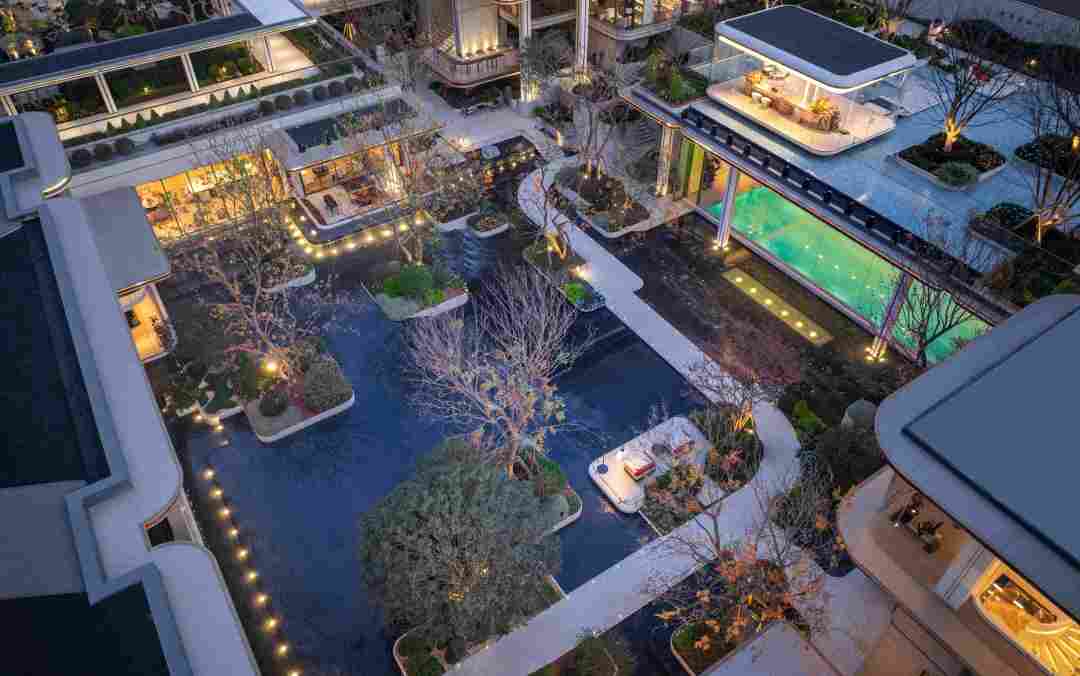
Space subtly transitions from city to home, with artistic conceptions progressing layer by layer: from the first glimpse of the gateway, to the enclosure of the serene courtyard by red travertine rock walls, where a lone tree calmly reflects in the water, creating an interplay of solid and void, evoking ethereal Zen. This culminates in a multi-level sunken courtyard inspired by the Qinling canyons—mountains and rivers are condensed here, achieving the ultimate residence of "entering nature."
02
A
To realize the elegant artistic form of the "Jade Tree," oversized, gradually curved UHPC (simulated Beige Travertine) components need to be fabricated and installed, with large-scale curved and straight sections prefabricated as a single UHPC element.
Challenge: Oversized UHPC components exceed conventional transportation and hoisting limits, processing errors increase exponentially, and extremely high demands are placed on prefabrication precision, on-site installation, and joint treatment.
Solution: Adopt a "front-end collaboration, reverse verification" model.
During the detailed design phase, a professional UHPC manufacturer was invited to participate, jointly discussing the splitting logic and process feasibility. In the fabrication stage, an innovative "large mold for small products" strategy was adopted: processing was done using a single large mold for the entire top opening, and then meticulously divided into panels that met transportation requirements and matched the overall effect. This successfully broke through conventional size limitations, ensuring the precision and integrity of the components.
In the final implementation stage, the panels were reinforced with a back-attached steel frame system, which was then securely and precisely connected to the main steel structure, ensuring the stability and flatness of the entire facade system.
This project incorporated BIM for full-process detailed design, re-modeling the architectural SU model using Rhino, and overlaying it with the steel structure model for rigorous facade collision checks.
From the outset of design, sufficient consideration was given to micro-adjustment needs during installation, reserving adequate adjustment space to accommodate potential on-site errors.
By pre-calculating structural deformation, the steel structure was pre-cambered to minimize structural errors, laying the foundation for precise installation of UHPC panels.
For bumps caused by transportation of panel edges, the project construction team performed professional on-site repairs, ensuring that every detail was perfectly presented.
Ultimately, this integrated system, combining structure, surface, details, and construction methods, perfectly blends the elegant imagery of the "Jade Tree" with the robust body of the architecture, presenting the beauty of modern construction with both strength and grace under light and shadow.
B
Achieving a balance between design effect and cost is a key focus for professional facade consultants in creating "Good Houses."
Challenge: The roofing system needs to achieve the best balance between controlling structural loads, ensuring waterproofing and sound insulation performance, controlling comprehensive costs, and achieving long-term maintenance-free results.
Solution: Introduce an optimized roofing system: "lightweight and efficient, long-lasting and low-maintenance."
The project introduced and deeply optimized a "lightweight roofing system" (steel structure+profiled steel sheet+thin concrete+gravel).Compared to traditional aluminum panel roofs, this construction significantly reduces structural loads while greatly enhancing waterproofing and sound insulation, fundamentally addressing the pain points of heavy loads and leakage.
Utilizing the physical properties of the surface gravel layer effectively conceals dust accumulation and stain marks, significantly reducing visual dirtiness, thereby achieving the"long-term maintenance-free"operational goal and thoroughly cutting down future maintenance costs.
C
Challenge: As the visual guide and core of the facade rhythm for the main entrance lobby, the flatness control of the terracotta louvre curtain walls on both sides directly relates to the overall aesthetic effect of the exterior facade. Any subtle deviation over large spans would be infinitely magnified.
Solution: The FORCITIS team proposed a systematic structural optimization scheme: "stainless steel tension rods + inner lining profiles+precise positioning pins."
High-strength profiles are embedded within each terracotta louvre, achieving three-dimensional adjustability through pre-installed positioning pins. This ensures no cumulative errors during installation, achieving millimeter-level flatness control comprehensively at the design and construction levels. The terracotta louvres stand straight and perfectly echo the sense of order and ceremony of the architectural space.
D
Challenge:As a dry-hung system, the long-term waterproofing reliability of terracotta panel facades, especially at weak points such as inter-floor areas and terraces, is the lifeline of residential quality.
Solution:Construct a systematic waterproofing system with "clear primary and secondary, multiple defenses."
Main waterproofing: An additional 1.2mm waterproof aluminum panel is uniformly added to the back of all terracotta panels. The waterproof panel overlaps with the structure, improving waterproofing reliability, serving as the first active waterproof layer.
Key area reinforcement: An inner flashing steel plate is set at the inter-floor areas; at the base of terrace parapets, a composite structure of "three layers of waterproofing + flashing steel plate" is used to completely block water seepage paths.
E
Challenge: The clubhouse, as the core social and spiritual space, embodies the designer's extreme pursuit of aesthetics. Using conventional curtain wall systems can lead to problems such as bulky frames and glass deformation, making it difficult to balance aesthetics and function.
Solution: The clubhouse in this project innovatively uses oversized fully glazed curtain walls+an ultra-narrow frame folding door system: selecting fully ultra-white tempered laminated glass, supported at the top and bottom edges, with concealed stress nodes. To reduce the presence of joints, a uniform 12mm light-colored sealant is used.
The team collaborated with other disciplines—thoroughly checking interior layouts, exterior landscape sightlines, and architectural form relationships, performing cross-disciplinary overlay analysis—to finally determine the optimal glass division arrangement scheme. This allows both interior and exterior to enjoy unobstructed views, truly achieving architectural invisibility, natural integration indoors, and a "boundless" extension of the facade.
Furthermore, the large panels have built-in SGP interlayers, significantly enhancing impact resistance, wind pressure resistance, and long-term durability, balancing aesthetics and performance.
High-quality "Good Houses" combine safety, aesthetics, and comfort. The detailed design of this project returns to the essence of "human habitation," maximizing humanized design.
Challenge: How to maximize landscape views while meeting practical needs such as ventilation, fire protection, and maintenance, without sacrificing interior and exterior aesthetics.
Solution: For different scenarios, this project developed adaptable refined systems:
Ultra-narrow frame window-wall opening system: Uses a 50mm ultra-narrow frame, achieving a pure effect of "seeing the vent but not the frame indoors, seeing the frame but not the vent outdoors."
Optimized French window design: The French window design uses fire-resistant glass balustrades, optimizing the structure. While ensuring fire protection and safety, it cleverly guarantees the overall coordination and unity of the building's exterior facade, meeting the indoor space's pursuit of ultimate transparency, and also facilitating cleaning and maintenance to maintain excellent quality.
Chang'an Yuhua, as the first Greentown "Yuehua Series" work in Northwest China, brings together a host of top design teams including GOA, GZDI, L&H, CCD, Li Yizhong, and Mujun. While inheriting the aesthetic genes of the "Yuehua Series," it also condenses Xi'an's profound historical and cultural essence, reinterpreting what a high-end living experience means.
Facing the highly challenging tasks of a large demonstration area, complex material systems, and multi-disciplinary cross-construction, the project team achieved a perfect unity of facade effect and performance within a tight schedule, thanks to refined design, systematic collaboration, and technological breakthroughs, laying a solid foundation for overall quality.
In the ancient capital of Xi'an, Chang'an Yuhua did not respond to history with heavy strokes but rather evoked a contemporary philosophy of "making light of heavy tasks" through a light and dynamic scene. From the initial glimmer of Yuhua's light and shadow to a boundless artistic conception of mountains and waters, what it ultimately presents is not just a building, but an ideal city embracing nature, art, and future living.