Chengdu Luxelakes Black Stone Island
-
Location
Sichuan, Chengdu
-
Client
Chengdu Wanhua Investment Group
-
Design
Line+
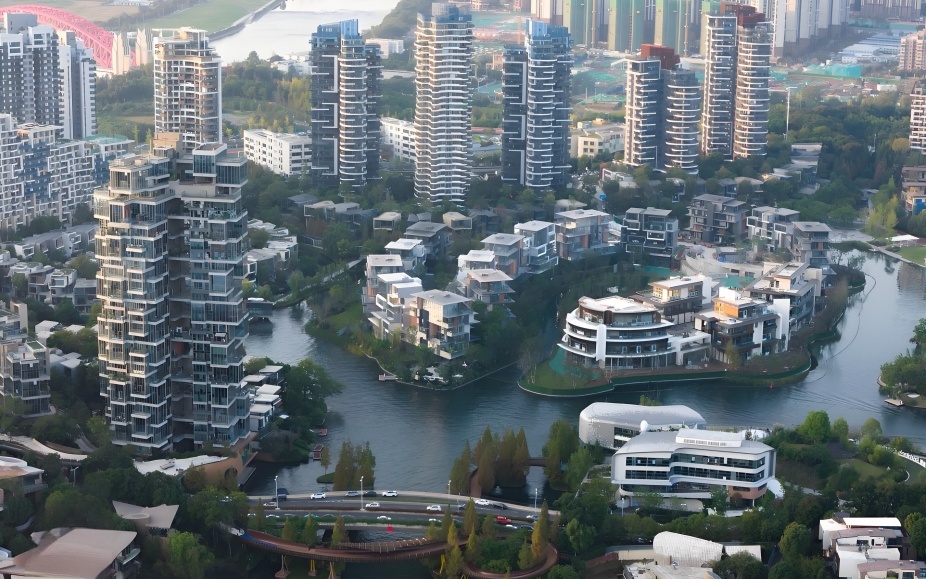
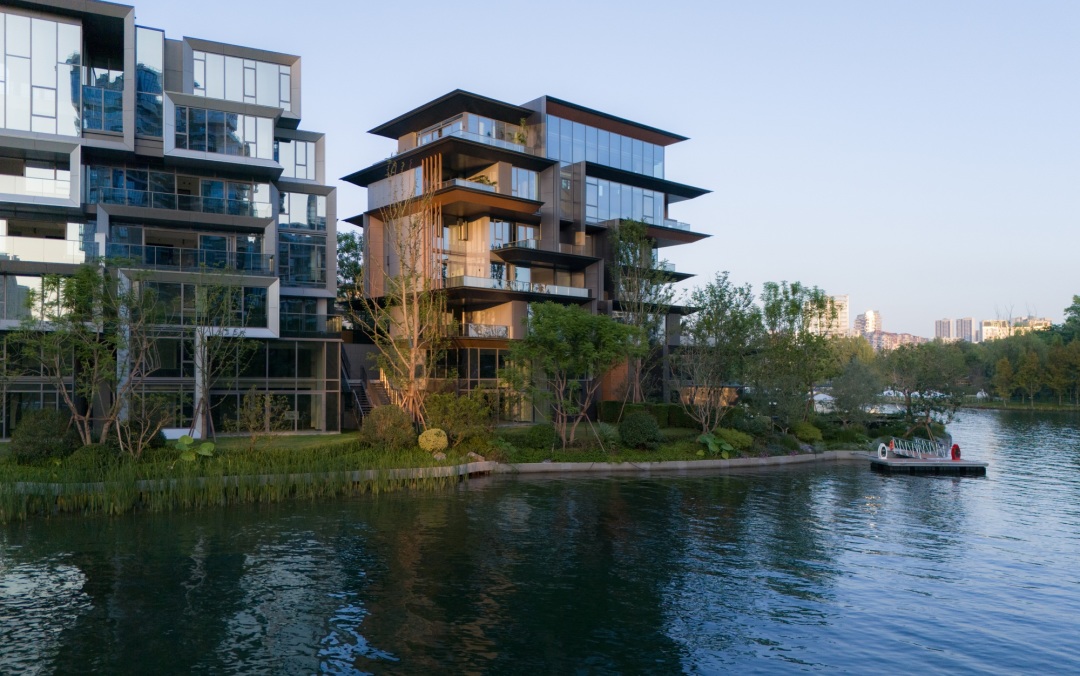
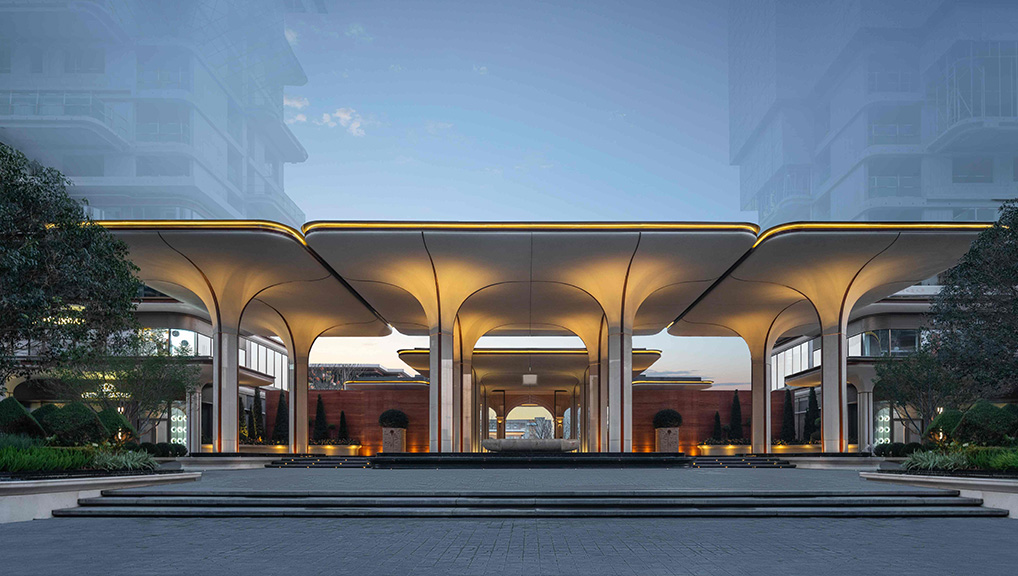
In the blueprint of Chengdu's Luxelakes, the "Black Series" not only represents a product line but also a narrative syntax for top-tier lakeside living: low-density, prime lake views, unique architectural aesthetics, and an irreplaceable symbiotic relationship with nature. As the latest work in this series, Black Stone Island not only embodies the newest expression of the "Black Series" product philosophy but also becomes a pioneering experiment in living forms and facade craftsmanship.
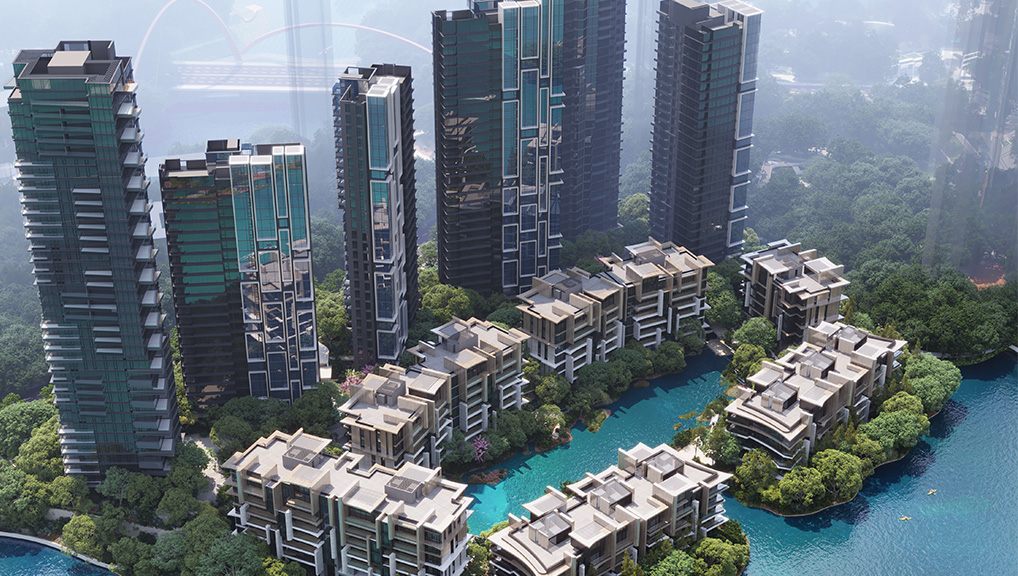
Black Stone Island is located in Chengdu Tianfu New Area, surrounded by water on three sides, boasting expansive peninsula lake views. As the latest masterpiece in the Luxelakes startup area, the project aims to create an urban waterfront community. It is planned with a "U" shape layout, maximizing the preservation of the original ecology. Through the staggered arrangement of buildings, it truly achieves "every home facing the lake, every household enjoying the view."
To achieve the dual goals of "transparent framing of views" and "introverted shaping," its facade system employs two distinct material and structural logics. At the architectural transitions, seamless integration and unified presentation are realized, collectively achieving unity of form and function.
The "Vertical Five-Villa" concept of Black Stone Island was developed by line+ co-founder Meng Fanhao, commissioned by Wanhua Group. This design, through modular deconstruction and non-standard floor design, breaks the traditional pattern of stacked villas without courtyards. It creates a "private villa" experience with independent ground or sky gardens for all unit types—lower, middle, and upper—achieving privacy for each household and allowing the courtyard concept to grow in the vertical dimension.
01
To dissolve the architectural volume, integrate it into the landscape, and echo the island's ecology, the facade design focuses on two objectives: shaping diversity of form through varied unit types, and while meeting individualized needs, optimizing landscape views and reducing visual interference.
Therefore, each unit features two main facades: one facing the lake, requiring ultimate transparency to capture views, and one facing the street, pursuing richness and introversion for shaping. The facade system needs to adopt two different logics in terms of materials, structure, and openness, achieving seamless transitions at the corners.
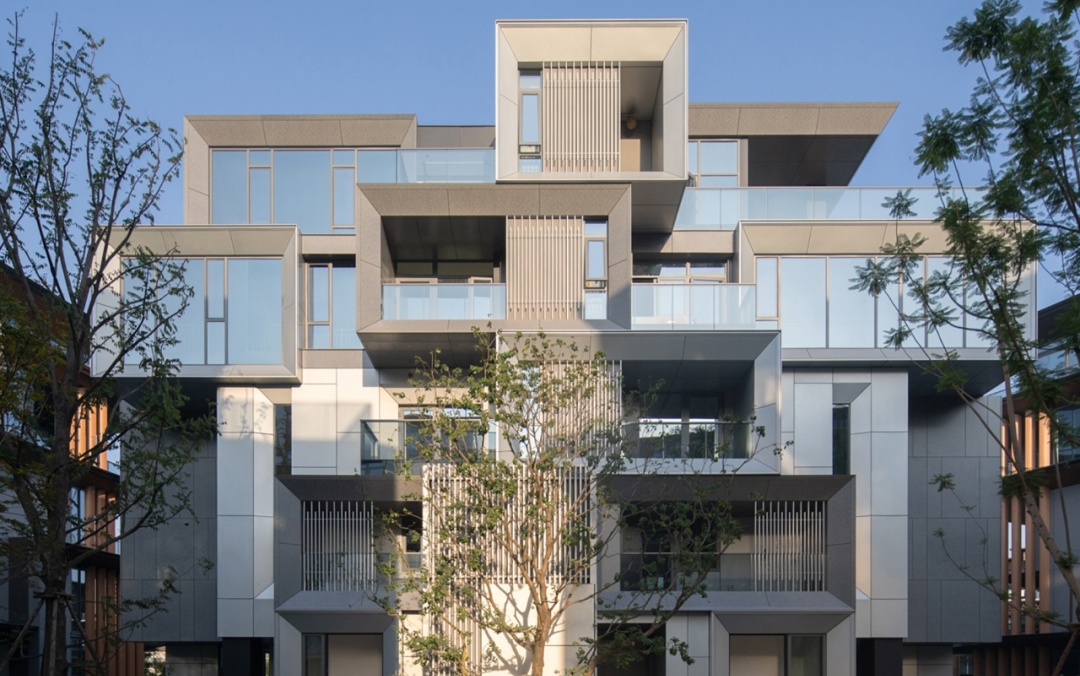
The "Surface-Volume" facade is inspired by building blocks, forming dynamic and jumping unit facades through the stacking, interlocking, and(staggering) of small blocks, presenting an overall effect of geometric block cutting and reassembly. The lateral enclosure design ensures residential privacy, avoiding visual interference between units.
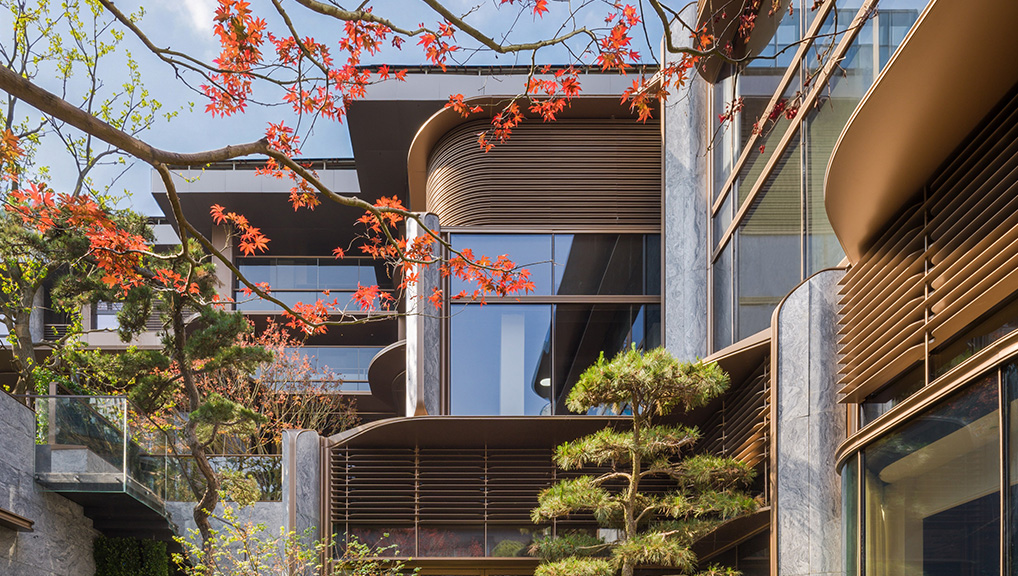
Materials chosen are light gray aluminum panels and "blue eye" marble, conveying light vitality through stacked volumes. The main black, white, and gray tones, combined with irregular patterns and grilles, create a crystal-clear facade effect, like ripples on a lake. Glass reflects the lake and sky, and aluminum panel blocks shift with sunlight, making the building itself seem like a transparent "black stone" on the lake, coexisting with nature.
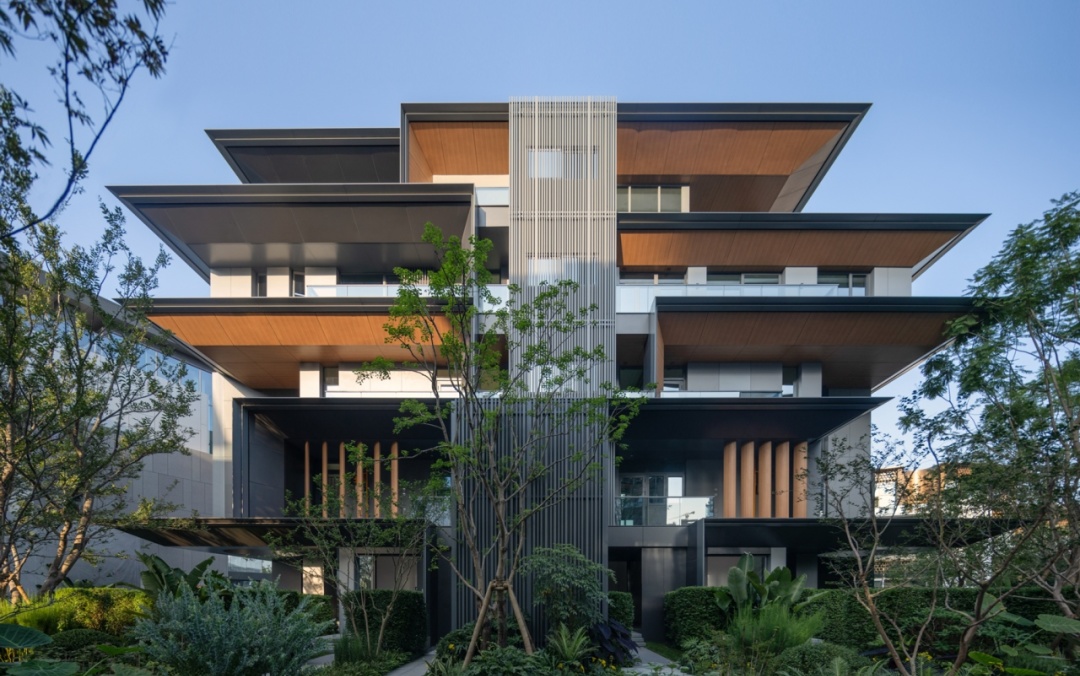
The "Line-Surface" facade uses inverted L-shaped three-dimensional folded plates to wrap the units, with the folded plates extending into external activity platforms. Horizontal lines stretch elegantly, metaphorically representing "wings of home"; combined with rhythmic changes in vertical lines, they collectively imbue the architecture with an approachable texture.
Materials used include wood-grain metal panels, dark gray stone, cement fiberboard, and corrugated metal panels, creating a calm and minimalist horizontal rhythm. The eaves structure draws inspiration from water ripples, presented with a three-dimensional multifaceted texture in wood veneer, and continuous grilles further enhance the overall sense of flow.
02
As the facade technical consultant, the FORCITIS team provided full-process integrated services, from system planning, technical solution design to material selection, node optimization, and cost control. Its core work was to address three structural challenges in the implementation of the "Vertical Five-Villa": the non-standardization of product prototypes, the dual character of dual facades, and the engineering realization of extreme forms—and to provide a systematic solution for these.
Extreme Realization of Eave Forms
To achieve the ultimate slender, thin, and integrated form of the building's eaves, traditional aluminum panels often face limitations such as non-straight edges, easy thickening of edges, and difficulty in controlling flatness when processing oversized components.
In response, we abandoned the traditional practice of using monolithic aluminum panels. All critical end profiles were made using custom aluminum extrusions.
For oversized dimensions up to 500mm, which exceed conventional domestic processing capabilities, an innovative design strategy of segmented profile splicing was adopted. Special weakening treatments were applied at the splices, allowing the seams to naturally blend into the profile's texture, thereby achieving a visually continuous and "seamless" effect.
Integrated Design of Eave Linear Drainage Channels
There is a fundamental contradiction between the building's clean geometric blocks and the necessary roof drainage function. If exposed drainage channels were used, eaves of different sizes would require different drainage slopes, which would inevitably damage the clean architectural silhouette.
Therefore, the project fully adopted a concealed (hidden) internal drainage system. For large areas, perforated aluminum panels were innovatively used as a decorative surface, allowing rainwater to naturally penetrate, while the structural layer underneath provided organized drainage, achieving "hidden drainage."
At the eaves, exposed drainage methods were completely abandoned. Drawing inspiration from landscape linear drains, the drainage function was cleverly integrated into the internal structural layers of the eaves, with access openings placed in concealed locations. This maintains the extreme appearance while ensuring ease of use and long-term maintenance.
Systematic Control of Facade Jointing in Complex Forms
For complex architectural forms composed of multiple stacked and interwoven blocks horizontally and vertically, the facade interface relationships are extremely intricate. This poses a severe challenge to the division and jointing design of facade panels. Improper jointing can easily lead to a chaotic facade logic, making the overall form appear fragmented.
To address this, we treated facade joints as "line language" to reinforce the architectural logic, ensuring that every joint strictly follows and echoes the interpenetrating relationships between the blocks, making them active elements in expressing the design intent.
In specific implementation, for every corner, turn, and junction, the team carried out personalized and rational division of metal panels. Through repeated effect simulations and refinements with digital models, it was ensured that the final implemented jointing accurately achieved the design intent of the scheme.
03
Great architecture's persuasiveness ultimately stems from a tangible feel at human scale and visual rigor. After overcoming systematic technical challenges, Luxelakes Black Stone Island shifted its construction focus to the ultimate pursuit of microscopic craftsmanship. Every grille joint, every coping closure, every block's turn and join underwent in-depth research and development from "standard options" to "customized optimal solutions."
Invisible Installation System for Suspended Grilles
Traditional aluminum welding often yields weak strength on thin-walled grilles, and exposed weld spots can destroy the slender lines of aluminum profiles. Furthermore, grilles are typically fixed to walls using exposed angle brackets and on-site sealant, which not only affects aesthetics but also poses a long-term risk of water leakage due to uncontrolled construction.
To eliminate the damage to profile lines from traditional welding or exposed bolts, the project used internal stainless steel rods for through-connection and set limiting gaskets between units. The installation system is completely hidden: the upper opening of the grille precisely inserts into pre-drilled holes, and the lower opening is sleeve-fixed, with only color-matched sealant used to treat the joints, achieving visual purity while completing pre-installed waterproof sealing.
Steel-Aluminum Composite Structure System for Louvered Grilles
The louvered grilles used in the project have large cross-sectional dimensions (400*120mm) and large horizontal spans (up to 6.7 meters). If pure aluminum grilles were integrally molded, not only would the mold cost be extremely high, but their structural stress and overall flatness would also be difficult to guarantee.
Therefore, in the system node design, the project opted for steel columns as the core load-bearing components inside the grilles, with separate aluminum profiles covering the outside as decorative surfaces. A male-female buckle interlocking method was used to ensure installation precision. This steel-aluminum composite structure system effectively controls costs while reliably ensuring the visual integrity and structural safety and stability of the facade.
To achieve the iconic multi-colored stacked block interlocking forms, reminiscent of the Lego House, using traditional aluminum panels directly joined at window edges would inevitably create numerous seams, disrupting the overall form and affecting visual perception.
After extensive communication with the architects and the client, the project innovatively designed all three-dimensional forms at the front of the windows as customized, integrated detail profiles.
This approach avoided the fragmented seams from multiple panel joints, perfectly restored the design intent, and also integrated the eave drip function, optimizing production and installation processes.
From "System" to "Scenario," Achieving an Island Living Prototype
Luxelakes Black Stone Island redefines lakeside living with its "Vertical Five-Villa" concept. From the ultimate realization of eave forms with customized profiles, to the meticulous planning of the architectural silhouette with invisible drainage, and to the precision-controlled jointing system like fine scales—under the long-term development strategy of Wanhua Group, FORCITIS and the client meticulously crafted this project. With its systematic facade technology integration capabilities and robust strength in tackling complex engineering, FORCITIS endowed this pioneering concept with a solid and exquisite physical form.
This is not just a facade engineering project; it is a complete closed loop from conceptual design to scenario creation. It allows the poetic vision of the "Black Series" to firmly land on this precious lake island, transforming into tangible, livable everyday art.